
THE 2026 PROPOSED AMENDMENTS TO THE B BBEE CODES – OVERLOOKED RISKS EVERY BUSINESS NEEDS TO KNOW
THE 2026 PROPOSED AMENDMENTS TO THE B BBEE CODES – OVERLOOKED RISKS EVERY BUSINESS NEEDS TO KNOW

The 2026 proposed amendments to the Broad-Based Black Economic Empowerment (B-BBEE) Codes of Good Practice have sparked widespread debate, particularly around the Enterprise and Supplier Development element.
Much of the public reaction has focused on the proposed Transformation Fund, but the more immediate and operationally disruptive changes lie within Preferential Procurement.
These proposed amendments fundamentally reshape from whom companies must buy and how higher ownership structures in their Suppliers influence scoring.
At the same time, a persistent misconception has taken hold that these amendments are replacing BEE. That is not accurate.
The current BEE scorecard remains largely unchanged, with significant amendments proposed to the Enterprise and Supplier Development Element (including Preferential Procurement).
The proposed amendments seem to have two main goals in mind:
- Promote the rollout of a BEE Transformation Fund for Enterprise and Supplier Development donations.
- Promote supplier procurement from 100% black-owned enterprises.
In this article we will focus on the potentially detrimental effect the proposed Preferential Procurement scorecard will have on business.
Comparison of current Preferential Procurement and Proposed Amendments to the BEE Scorecard
Under the current B-BBEE framework, companies earn points for procuring from suppliers with compliant B-BBEE Levels, particularly those that are EMEs, QSEs, more than 51% black-owned or more than 30% black women-owned.
The following summary outlines the proposed amendments and the resulting impact on the BEE scorecard points allocation:
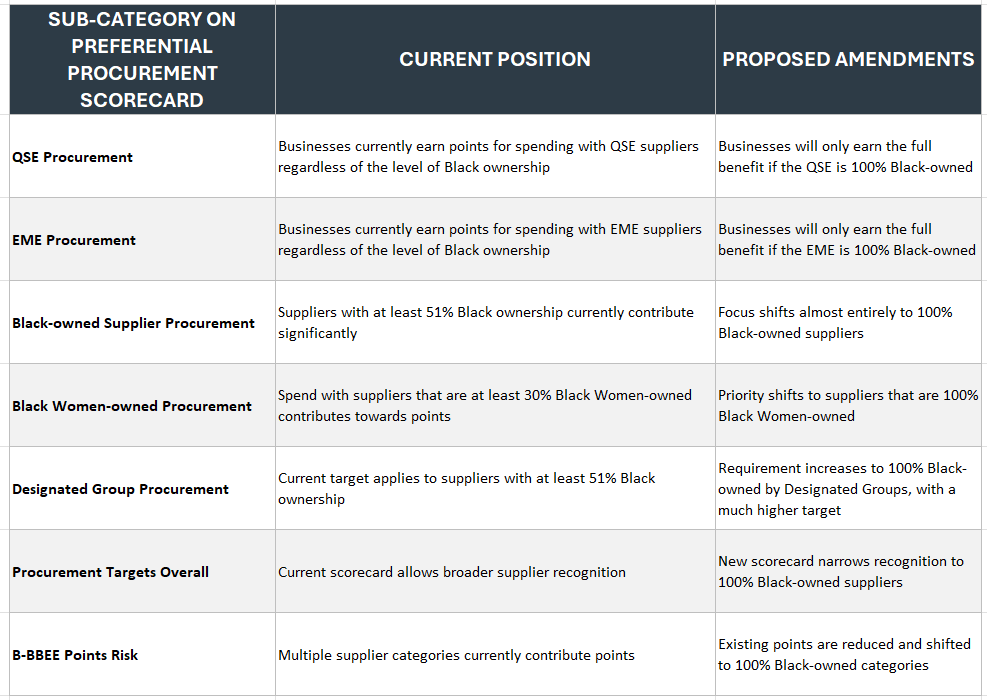
The practical implication of the proposed amendments is that businesses that previously relied on large, established suppliers with 51% Black ownership may now find themselves losing points, unless they actively diversify towards 100% Black-owned businesses (EMEs and QSEs).
A significant barrier to achieving these new proposed procurement guidelines is that these 100% black-owned, B-BBEE-compliant suppliers are hard to find.
We conducted an analysis of 10 903 supplier certificate searches across actual client procurement data:
- Each of the proposed 100% Black-owned categories represents less than 2% of available suppliers;
- The current supplier base within South Africa does not support the proposed thresholds and may lead to the following:
Increased fronting risk
- Likelihood of artificial structures being created to meet targets;
- Emergence of “procurement hubs” that inflate costs without real transformation.
Supplier non-participation
- Many 100% black-owned entities opt not to obtain full B-BBEE certification;
- Reliance on ownership certificates alone results in non-compliant procurement recognition.
Increased cost of doing business
- Supply chain inefficiencies;
- Price inflation due to limited supplier pools.
The importance of Procurement as a Priority element on the BEE scorecard
Procurement is a priority element, which in practice means that 40% of the Procurement points should be achieved to prevent being discounted a B-BBEE level, regardless of performance in other elements. Companies with higher B‑BBEE levels have already maximised points across the remaining scorecard elements and therefore face a real risk of B‑BBEE level regression if they cannot align their procurement strategies with the increasingly stringent procurement requirements.
While the Transformation Fund has drawn headlines, the Procurement element is what matters most because––
- procurement is where day-to-day compliance happens;
- real economic participation is most effectively driven through procurement, which remains the dominant motivator within the B‑BBEE framework, given that a company’s compliance is directly linked to the compliance status of its supplier base.
Conclusion
By tightening procurement requirements to give exclusive preference to 100% black‑owned enterprises, the proposed amendments aim to fast‑track the growth of fully black‑owned businesses. In practice, however, they risk achieving the opposite.
The limited availability of 100% black‑owned, B-BBEE-compliant suppliers across many sectors may make procurement compliance difficult for many companies, leading to B‑BBEE level downgrades, reduced competitiveness, and exclusion from tenders.
Rather than expanding participation, these requirements could narrow supply chains, exclude otherwise compliant majority black‑owned businesses, undo existing transformation progress, and slow down economic activity, ultimately undermining the goal of sustainable and inclusive empowerment. We encourage our clients and other businesses to contact us for specific guidance on the above matter.
SERR Synergy, in association with various SANAS-accredited agencies, provides a complete range of B-BBEE Verification Services. We have developed a sound and comprehensive verification methodology in order to simplify and rationalise the BEE audit process. We assist clients in the verification process step-by-step and our services include assistance with the issuing of an accredited BEE verification certificate by an accredited verification agent.
About the Author: Lizeri Bosch is a Senior B-BBEE Professional and joined SERR Synergy in January 2022. She holds a B.Com Law and LLB from the North-West University, Potchefstroom and was admitted as an Advocate in 2021.


