
Practical guide to claim points for Responsible Social Marketing and Communications under the MAC Sector Codes
Practical guide to claim points for Responsible Social Marketing and Communications under the MAC Sector Codes

Since 1 April 2016, the Marketing, Advertising and Communication Sector Codes (MAC Sector Codes) have been gazetted by the Department of Trade, Industry and Competition (DTIC).
They are applicable to the Advertising, Public Relations and Communications Industries and are to be used as vehicles in all media, including digital platforms such as the internet or social media. As with many other B-BBEE Sector Codes, the MAC Sector Codes also have a requirement that is unique to the associated industries.
If a company is deemed to be a Qualifying Small Enterprise (QSE) or Generic/Large entity measuring under this charter, it can score 5 extra points for implementation of Responsible Social Marketing and Communications.
How do you know if your company/organisation should be measured under the MAC Sector Codes?
If the core of your business is the conceptualisation, creation, production and implementation of communication as a marketing tool in two or more of the following disciplines, your company will in all likelihood be measured under the MAC Sector Codes:
- Advertising;
- Public Relations;
- Experiential; or
- Design.
What is the MAC Sector Codes turnover threshold?
It is important to take note of the turnover threshold to ensure that a company measures under the correct scorecard.
The requirements for Responsible Social Marketing and Communications differ depending on whether the company is deemed to be a QSE or Generic/Large entity:
- Qualifying Small Enterprises (QSEs):

- Generic/Large Enterprises:

It is of utmost importance to ensure that your company falls under the correct industry/sub-sector when determining the turnover threshold.
What is Responsible Social Marketing and Communications (RSM)?
This element comes into play when you are deemed to be a QSE or Generic/Large Entity in terms of the MAC Sector Codes.
There is, however, a slight difference in the requirements.
A QSE needs to contribute 2% of its indicative Net Profit After TAX (NPAT) to RSM Initiatives, whereas a Generic/Large entity must spend 2,5% of its indicative NPAT towards RSM Initiatives if it wants to score points under this element.
- Qualifying Small Enterprises (QSEs):
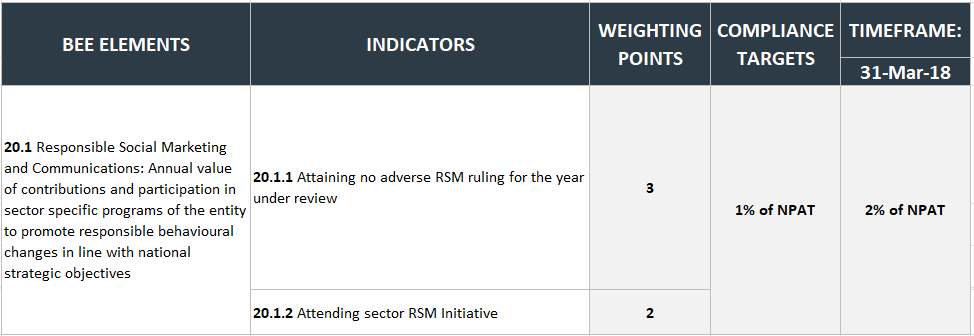
- Generic/Large Enterprises:

A contribution should be made by MAC Sector Entities towards “the promotion of responsible social marketing through involvement in a programme designed to propound, propagate and entrench responsible social marketing”.
How do I apply this requirement to claim points for B-BBEE in practice?
The requirement is broken down into the following 2 categories:
- Category 1: No Adverse RSM Ruling (for 3 points):
To show that a company has no adverse ruling against it and claim points for B-BBEE purposes, you can apply to the Advertising Regulatory Board (ARB) for a “MAC Certificate”. This is basically seen as a “No Adverse Rulings Letter”.
You can apply to the Advertising Regulatory Board as follows:
- Request an invoice;
- After the invoice has been paid, you need to send the following documents:
- Company Registration Documents;
- Certificate Copy of ID of Directors;
- VAT Registration Certificate;
- Letter or Affidavit confirming that the company had no adverse ruling against it for the preceding 12 months; and
- Proof of payment.
- Category 2: Attendance of RSM Initiatives (for 2 points):
The objective of these contributions is to encourage society to “embrace habits and practices that contribute to its collective well-being and welfare in line with the national agenda and the best interest of society”. This can be achieved by making contributions to initiatives that communicate the importance of responsible behaviour in society, for example Arrive Alive or Gender-Based Violence initiatives.
Given the ever-evolving times we live in, it is not difficult to see why such initiatives should be implemented. How this ties together with B-BBEE is another question.
About the Author: Shaun Venter is a Project Manager / B-BBEE Professional who joined SERR Synergy in May 2022. He holds an LL.B degree from the University of the Free State and is an Admitted Attorney of the High Court of South Africa.


