
HAZARDOUS GOODS MANAGEMENT IN SA: ONE SPARK, BIG CONSEQUENCES
HAZARDOUS GOODS MANAGEMENT IN SA: ONE SPARK, BIG CONSEQUENCES
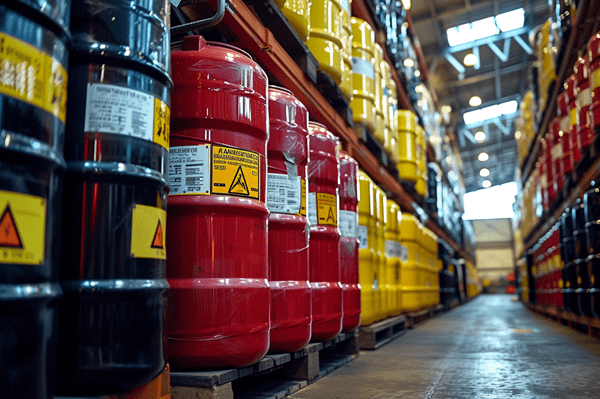
A single spark can change everything. In July 2021, the UPL warehouse fire in Durban released over 1 600 hazardous chemicals, contaminating rivers, killing marine life, and forcing thousands to evacuate their homes (Daily Maverick, 2021).
For many South African business owners, this incident served as a critical wake-up call: ineffective hazardous goods management is not merely a compliance risk that leads to fines, but a serious business threat that can devastate lives, livelihoods and the environment.
Chemical exposure remains one of the leading causes of occupational illness in South Africa, according to the Department of Employment and Labour (2019). With stricter enforcement of the Occupational Health and Safety Act (OHS Act No. 85 of 1993) and municipal by-laws, business owners and compliance officers can no longer afford to treat hazardous goods management as an afterthought.
In a previous article we discussed Flammable liquid safety regulations with key practices for SA businesses.
Here is a quick Hazardous Goods Management guide as to what you need to know—and what you must do—to stay compliant and operate safely.
Safe handling in warehousing and storage
Effective training significantly reduces risk. The SAQA-registered course, with specific reference to Unit Standard 242996, teaches employees how to correctly identify, classify, label and store dangerous goods (SAQA, 2023a). It directly supports the Hazardous Chemical Agents Regulations by ensuring that workers understand the nine classes of dangerous goods and how to segregate incompatible substances, ventilate areas and prevent spills.
Research indicates that proper classification and segregation alone can prevent a substantial proportion of storage-related incidents (HKA, 2022). Begin by auditing your current storage practices today—one of the simplest and most impactful steps towards compliance and workplace safety.
Moving and storing hazardous loads
South Africa’s roads remain dangerous for heavy vehicles, with thousands of fatal truck accidents recorded in recent years, many involving hazardous cargo (Road Traffic Management Corporation, 2023).
Comprehensive training helps to reduce accidents, lowers insurance premiums, and keeps your supply chain running smoothly.
The SAQA-registered course, with specific reference to Practical Unit Standard 260837, focuses on the safe handling and movement of hazardous loads (SAQA, 2023b). Learners develop essential skills, including pre-movement inspections, stable stacking, proper use of PPE, and emergency spill response—critical competencies for transporting or relocating dangerous goods within or between sites.
Fire Department Registration
Most municipalities in Gauteng, KwaZulu-Natal and the Western Cape require a Certificate of Registration from the local Fire Department before you may store or handle flammable or hazardous substances. This certificate is issued only after the Chief Fire Officer has inspected and approved your premises.
Typical substances that trigger this requirement include––
- diesel, petrol and paraffin
- LPG cylinders and installations
- solvents (acetone, thinners, turpentine, MEK)
- paints, adhesives and alcohol-based products
- industrial chemicals (toluene, xylene, etc.).
Key municipal by-laws include––
- KwaZulu-Natal Fire Fighting Services By-laws – Section 36
- Western Cape Community Fire Safety By-law, 2002 – Section 38(1)
- Gauteng Emergency Services By-laws – Section 21(1).
You also need valid Electrical and Gas Certificates of Compliance, plus full alignment with the Hazardous Chemical Agents Regulations (updated SDSs, risk assessments and training records).
Conclusion
Small, proactive steps can deliver big protection—helping you avoid fines, shutdowns and serious incidents. Stay ahead by updating your chemical inventory and SDS folder, checking expiry dates on spill kits and fire extinguishers, scheduling accredited training for staff handling hazardous goods, and ensuring that your premises have a current Fire Department Certificate of Registration.
At SERR Synergy, we make this simple. Send us your current chemical list and Safety Data Sheets, and we will compile your Hazardous Chemical Risk Assessment as part of your safety file. Beyond health and safety management, we support businesses with labour and employment compliance, legal advisory services, and integrated risk management—helping you protect your people, operations and reputation.
About the Authors: Cherize van Deventer and Prudence Sikhwetha are compliance specialists at SERR Synergy with over 15 years of combined experience in occupational health and safety. They help South African businesses navigate complex legislation and create practical, sustainable safety systems.
Reference List:
- City of Cape Town. (2002). Community Fire Safety By-law, 2002. https://openbylaws.org.za/akn/za-cpt/act/by-law/2002/community-fire-safety/eng@2015-08-21
- City of Johannesburg. (2004). Emergency Services By-laws, 2003. https://www.saflii.org/za/legis/bylaws/jhb/esb2003254/
- Daily Maverick. (2021). UPL fire: Here's the full inventory of chemicals…https://www.dailymaverick.co.za/article/2021-08-18-upl-fire-heres-the-full-inventory-of-chemicals-in-the-destroyed-cornubia-warehouse/
- Department of Employment and Labour. (2019). The Profile: Occupational Health and Safety South Africa. https://www.labour.gov.za/DocumentCenter/Publications/Occupational%20Health%20and%20Safety/The%20Profile%20Occupational%20Health%20and%20Safety%20South%20Africa.pdf
- Health and Safety International. (2024). Hefty fines for non-compliance…https://www.healthandsafetyinternational.com/article/1885490/hefty-fines-non-compliance-south-africas-new-ohs-law-changes
- HKA. (2022). Fire safety issues related to the storage…https://www.hka.com/article/fire-safety-issues-related-to-the-storage-and-handling-of-consumer-goods-containing-hazardous-materials/
- KZN COGTA. (2020). Fire Fighting Services By-laws. https://www.kzncogta.gov.za/wp-content/uploads/2020/11/8.1.6%20Fire%20Fighting%20Services%20By-laws.docx
- Mulaudzi, T., et al. (2025). A risk-based review of dangerous goods storage…https://link.springer.com/article/10.1007/s00170-025-15778-3
- Occupational Health and Safety Act (No. 85 of 1993). Republic of South Africa.
- Road Traffic Management Corporation. (2023). Fatal Truck and Bus Crashes in SA. https://www.rtmc.co.za/images/rtmc/docs/research_dev_rep/Fatal-Truck-and-Bus-Crashes-in-SA---March-2023.pdf
- SAQA. (2023a). Unit Standard 242996. https://regqs.saqa.org.za/showUnitStandard.php?id=242996
- SAQA. (2023b). Unit Standard 260837. https://regqs.saqa.org.za/showUnitStandard.php?id=260837


